A vendor-neutral reference architecture for the modern data platform: the functional layers every team needs - ingestion, storage, processing, serving, orchestration, governance, observability - and the real open and managed options at each one.
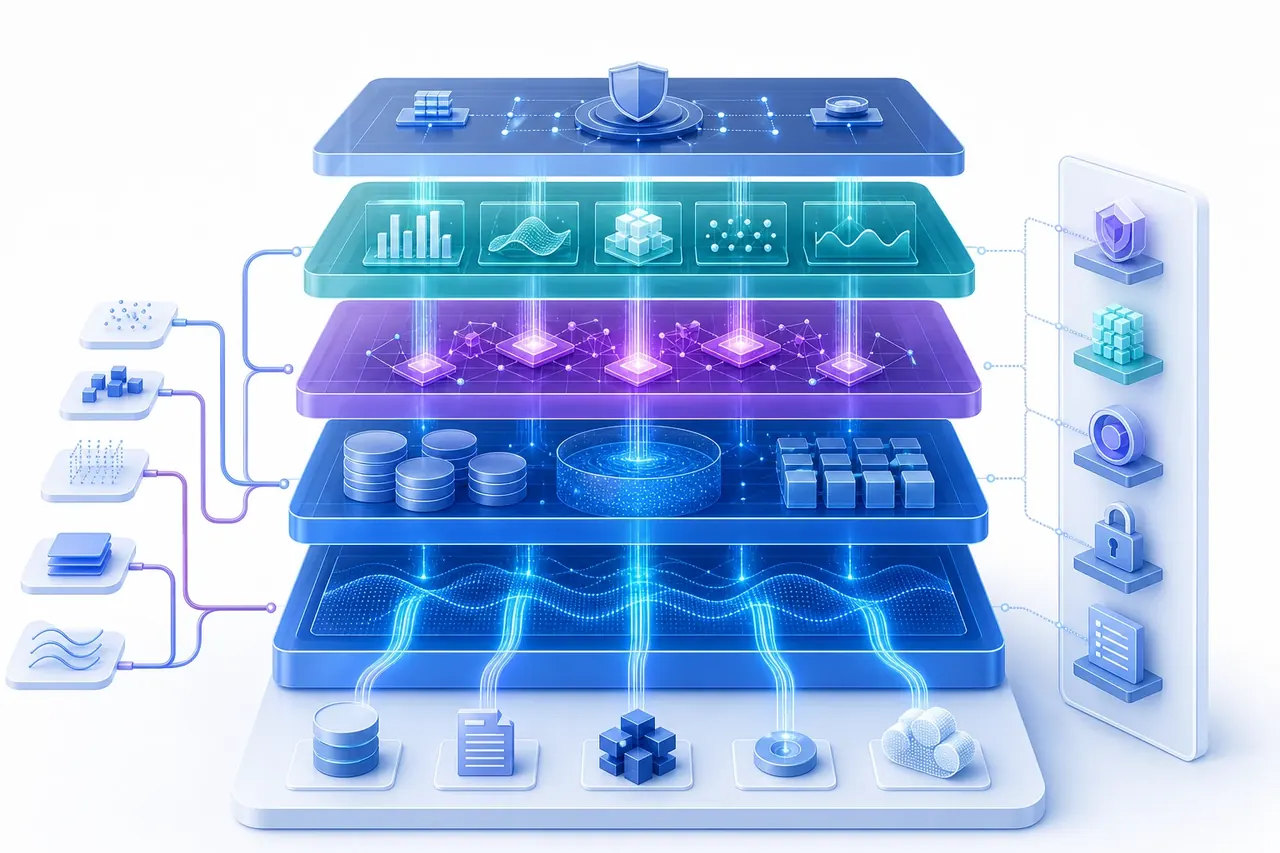
A useful data-platform design starts with responsibilities: moving data, keeping it trustworthy, and serving the people and applications that need it. Product choices come after the required freshness, ownership and recovery behavior are clear.
The seven-layer map below is a way to check that those responsibilities are covered. One service may cover several layers. Clear interfaces can reduce migration work, but replacing a component still requires compatibility and operational testing.
This updates our 2022 architecture map with open table formats, more streaming options and stronger catalog integrations. Batch remains appropriate for scheduled consumers. The ClickHouse examples and comparisons use 26.8 LTS.
The seven functional layers
Strip away brand names and every credible architecture exposes the same seven responsibilities: ingestion and change capture, storage and table format, processing and transformation, serving and query, orchestration, governance, and observability.
The layers are responsibilities, not servers. One tool can cover several (ClickHouse is both storage and a serving query engine) and one layer can be split across several tools. Thinking in layers forces you to ask "is this responsibility covered?" before "which product?". Vendor diagrams usually collapse this into five boxes (ingestion, storage, processing, consumption, governance). For engineers who carry the pager, orchestration and observability deserve to stand on their own, because they are where platforms quietly fail.
Read the table as "cover each responsibility; one tool can cover several rows."
| Layer | What it has to do | Representative open / self-hosted | Representative managed |
|---|---|---|---|
| Ingestion + CDC | Get data in, capture row-level changes from source databases | Debezium, Kafka Connect, Airbyte, Apache NiFi | Fivetran, AWS DMS, Confluent Cloud, Estuary |
| Storage + table format | Durable, queryable storage with schema, snapshots, time travel | Apache Iceberg, Delta Lake, Apache Hudi on object storage | Snowflake, Databricks, BigQuery, S3 Tables |
| Processing + transformation | Reshape, join, and model raw data into trusted tables | Spark, Flink, dbt OSS, SQLMesh | dbt Cloud, Databricks, Confluent Flink, EMR |
| Serving + query | Answer analytical and operational queries with low latency | ClickHouse, Trino, DuckDB, Apache Druid | ClickHouse Cloud, Athena, BigQuery, Snowflake |
| Orchestration | Schedule, sequence, retry, and backfill pipelines | Apache Airflow, Dagster, Prefect | Astronomer, Dagster+, MWAA, Google Cloud Composer |
| Governance | Catalog, lineage, access control, classification | DataHub, OpenMetadata, Apache Polaris, Unity Catalog OSS | Unity Catalog, Snowflake Horizon, Atlan, Collibra |
| Observability | Detect freshness, volume, and quality regressions before users do | OpenLineage, Great Expectations, Elementary | Monte Carlo, Metaplane (Datadog), Bigeye |
A tool appearing in two rows is not a mistake. Storage engines grew query layers, query engines learned to write open table formats, and catalogs absorbed lineage and observability. The layer model tells you what a converged tool is actually doing under the hood.
Storage and the table format question
Storage is where the 2022-to-2026 shift is most visible. An open table format (Apache Iceberg, Delta Lake, Apache Hudi) turns a directory of Parquet files in object storage into a real table, with schema evolution, ACID transactions, and time travel, readable by any compliant engine.
Warehouses increasingly support open tables alongside native storage. Databricks' Iceberg announcement and Snowflake's Iceberg documentation describe different catalog and access modes. Verify format versions, data types, deletes, writes and policy enforcement for each client. Replacing Trino with ClickHouse can require SQL changes and a native serving copy; projections on MergeTree are not a transparent acceleration layer over arbitrary external Iceberg tables.
Interactive workloads may benefit from a native serving copy with suitable indexing or pre-aggregation. Measure direct lake queries first: they may already meet the target. A second store adds synchronization, freshness, and recovery responsibilities, so justify it with a workload rather than an assumed universal latency gap.
Ingestion: match delivery to the consumer
Choose streaming where consumers need continuous updates and batch where scheduled delivery is sufficient. CDC describes how source changes are captured, while batch and streaming describe how they are processed. A platform can use all three without inconsistency.
Three ingestion patterns cover almost everything, and most real platforms run all three:
- Change data capture (CDC). Stream row-level inserts, updates, and deletes out of operational databases by reading the transaction log. Debezium into Kafka is the open-source standard; AWS DMS and Fivetran are the managed equivalents. CDC is how you get OLTP data into the analytics plane without hammering production with polling queries, a split we examine in OLTP vs OLAP in 2026.
- Event streaming. Application and clickstream events land directly on Kafka or a Kafka-compatible log (Redpanda, Confluent Cloud), then fan out to storage and stream processors.
- Batch and zero-ETL. Periodic loads for legacy systems and slow-moving reference data, plus the managed "zero-ETL" replication paths cloud vendors offer between their own services.
The pitfall is treating CDC as fire-and-forget. CDC logs can be append-only sequences of change events, but a downstream consumer has to interpret update and delete semantics or it will double-count. As Gunnar Morling shows in his walkthrough of ingesting Debezium events with Flink SQL, the connector and format together decide whether events are read as an append-only stream or a changelog, and getting that wrong corrupts every aggregate downstream. Design the ingestion contract before you pick the tool. Our primer on what a data pipeline is sets the foundations, and ETL process optimization covers tuning the batch paths you keep.
Processing, serving, and orchestration
Processing and transformation may use SQL models, batch engines or stateful stream processors. dbt and SQLMesh organize transformations and their dependencies; Spark and Flink support broader execution needs. As of the September 2026 dbt release notes, dbt v2 is the Rust-based generation, with a separate Apache-2.0-only dbt OSS distribution. Check adapter support and licensing for the exact distribution. Do not assume a model transfers unchanged between warehouse SQL and streaming SQL.
Serving and query must meet a measured latency and concurrency target. Direct lake queries may be sufficient; a native serving store adds indexing, caching or pre-aggregation options at the cost of another maintained copy. Compare both before assuming every interactive application needs a second engine.
Orchestration ties it together. The question an orchestrator answers is "what runs after what, what happens when it fails, and how do I backfill three months of history without a war room." Airflow remains the incumbent; Dagster and Prefect compete on asset-centric and Pythonic developer experience. Pick based on whether your team thinks in tasks (Airflow) or in data assets (Dagster). Either way, this layer stops being optional the moment you have more than a handful of dependent jobs.
Governance and observability
These two layers separate a platform from a pile of pipelines, and they are where most teams under-invest until an incident forces the issue.
Governance includes discovery, ownership, lineage and authorization, which may be implemented by different systems. OpenLineage standardizes lineage events; it does not enforce access controls. Catalogs such as DataHub and OpenMetadata can ingest metadata, while table catalogs coordinate table discovery and commits. If an AI agent can modify metadata through an API or MCP server, grant it only the permissions that workflow needs.
Observability is monitoring for the data itself: freshness, volume, schema drift, quality, detected before a stakeholder notices a dashboard went stale. Open tools (Great Expectations, Elementary, the OpenLineage spine) and managed platforms (Monte Carlo, Metaplane) cover the same job: catch it before the CFO's dashboard goes stale. Treating pipelines with the same operational rigor as production software is what DataOps is about. Instrument lineage and quality from day one. Retrofitting observability onto a platform that has already lost its users' trust costs far more than building it in.
Right-sizing: what to skip
A small team need not deploy a separate product for every responsibility. Begin with the simplest set of services that meets the workload, while retaining ownership, access controls, recovery, and quality checks.
A reasonable progression:
- Early stage. A managed warehouse or database, reviewed transformations and scheduled loads may cover the workload. Keep ownership, access controls, backups and freshness checks even if you skip a standalone catalog or observability product.
- Growth stage (a platform team, multi-terabyte, real-time needs emerging). Introduce an open table format so you are not locked to one engine, add CDC and a streaming path for the workloads that need it, and stand up a real catalog and observability layer. A typical stage-2 stack: Debezium into Kafka, Flink or Spark writing Iceberg on S3, dbt on top, ClickHouse for the hot path, Airflow, DataHub.
- Enterprise. Assign owners for all seven responsibilities and test controls across teams and engines. Regulatory requirements depend on the jurisdiction, data and application; an architecture diagram or catalog installation does not establish compliance.
The layer model helps because it tells you what you are skipping: a responsibility you have decided you do not yet need, with a name, so you know what to add when the time comes.
Building or modernizing a platform like this? Architecture and implementation for these stacks is what our data engineering consulting practice does, from streaming ingestion through the analytics layer.