

 Itamar Syn-Hershko
In 2026 keyword search will not be enough. Modernize search with OpenSearch using semantic vectors, hybrid search, and query intent understanding for AI-ready, relevant results.
Picture this: you search for "small lion" and get results showing a tiny lion figurine instead of a lion cub. That disconnect between what you meant and what you got represents the fundamental problem with traditional keyword search - and exactly why search modernization matters.
Search modernization is about moving beyond simple keyword matching to understand what users actually mean when they search. Traditional keyword search treats queries as literal strings of text - if you search for "crown," you get documents containing that exact word. But if you're British and actually referring to the monarchy, those results miss the mark entirely. Modern search bridges this gap by incorporating semantic understanding, allowing systems to grasp meaning rather than just matching words.
Why It Matters Now More Than Ever
The rise of AI agents has made search modernization urgent. When a chatbot or AI assistant needs to retrieve information, it generates its own search queries, and those queries won't necessarily use the exact words that appear in your documents. If your search system relies purely on keyword matching, AI-powered applications will fail to find relevant information even when it exists in your data. For e-commerce sites, internal knowledge bases, and any application where users expect intelligent results, the old approach simply doesn't cut it anymore.
How OpenSearch Enables Modern Search
OpenSearch, the open-source search engine maintained under the Linux Foundation, has evolved into a powerful platform for semantic and AI-ready search. With over 15 years of development history tracing back to Elasticsearch (from which it was forked), OpenSearch offers a proven, scalable foundation with a rich ecosystem of tools and support options. It handles everything from traditional keyword search to sophisticated vector operations, making it well-suited for organizations ready to modernize their search infrastructure. And it's a great VectorDB to use.
Key Concepts in Search Modernization
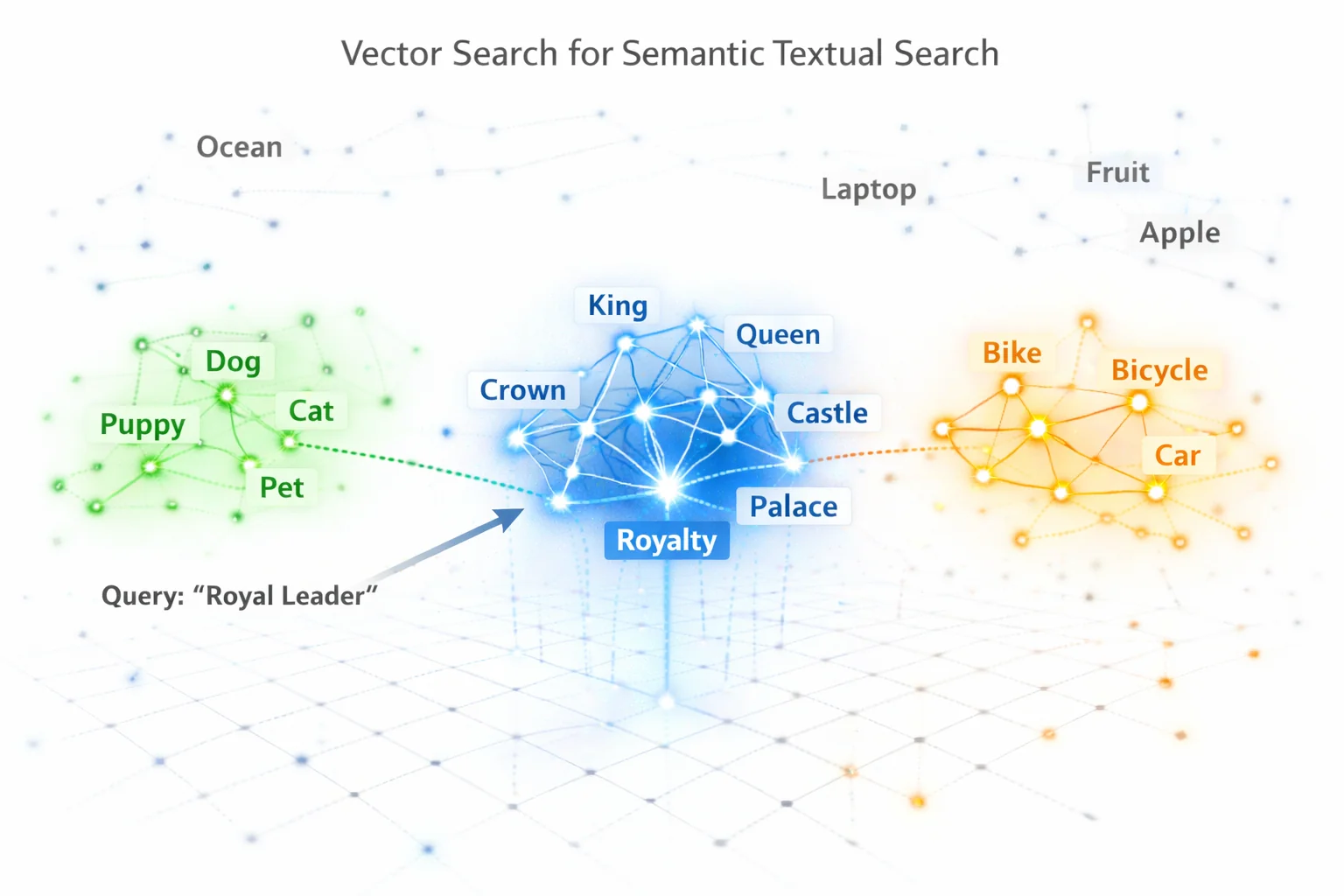
Vector Search and Semantic Understanding. The core of modern search lies in vector embeddings - a mathematical representations of text that capture meaning. When you pass a query through an embedding model, it produces a vector that sits close to semantically similar concepts in a multi-dimensional space. "Crown" ends up near "king," "queen," and "castle." This allows search to find conceptually related documents even when the exact words don't match. OpenSearch supports both sparse vectors (simpler, faster, cheaper) and dense vectors (more nuanced semantic capture via LLM-based embedding models).
Hybrid Search. Pure semantic search has limitations: it can struggle with specific names, technical terms, or queries where exact matching matters. Hybrid search combines the best of both worlds: semantic vector search for meaning and traditional keyword search for precision. Using algorithms like Reciprocal Rank Fusion (RRF), hybrid search merges results from multiple approaches to surface the most relevant documents. This addresses both precision (returning exactly what was asked for) and recall (not missing relevant documents that use different terminology).
Query Intent Understanding. Perhaps the most powerful advancement is using language models to understand what users actually want. When someone searches for "cheap laptop," the word "cheap" won't appear in product descriptions- but an LLM can recognize this as a price filter and adjust the search accordingly. Similarly, searching for "red dress" can be decomposed into a color filter (red) and a product category (dress). This intent extraction, powered by fast, affordable models like Amazon Nova, transforms vague queries into precise, structured searches. We have previously blogged about such a use case, Synonym expansion with LLMs using Amazon OpenSearch Service and Amazon Bedrock .
Business Signal Boosting. Search relevance isn't purely about semantic similarity. A news site should prioritize recent articles; an e-commerce platform might boost bestsellers. Modern search systems allow business logic to influence rankings through decay functions on timestamps, boosts for popular items, and other customized scoring adjustments that align results with organizational priorities.
Re-ranking. For cost-effective optimization, re-ranking retrieves a larger initial set of results using faster methods, then applies more sophisticated AI models to reorder just the top candidates. This approach balances computational expense with result quality, making advanced relevance improvements practical at scale.
Measuring Success
Search modernization requires ongoing measurement. Key metrics include zero-result queries, abandoned searches, click-through rates, and standardized relevance scores like NDCG@10. OpenSearch provides built-in relevance benchmarking tools, allowing teams to establish baselines, create judgment lists, and systematically improve their search quality over time.
Getting Started
The good news is that search modernization is now accessible to organizations of all sizes. Embedding models have become affordable and fast. OpenSearch's documentation provides comprehensive guidance on implementing vector search, hybrid approaches, and semantic capabilities. For most use cases, starting with sparse vectors offers a cost-effective entry point, with dense vectors available when stronger semantic understanding is needed. Scaling vector search might be a challenge, but we already have the solutions for it.
Query intent understanding, once a complex undertaking, has become straightforward with modern LLMs. Even basic prompt engineering can extract categories, attributes, and search terms from natural language queries, dramatically improving the relevance of results.
The era of purely keyword-based search is ending. Users expect systems that understand them, AI agents demand semantic comprehension, and the tools to deliver both are ready. Search modernization with OpenSearch isn't just possible - it's the new standard.
Need help? The experts at BigData Boutique are always ready for a new challenge. Learn more about our OpenSearch consulting services or get in touch.
Watch the full webinar: