

A vendor-neutral, head-to-head comparison of enterprise data warehouses, data lakes, and lakehouses - with a clear view of the BI, governance, and latency workloads where the EDW still wins in 2026.
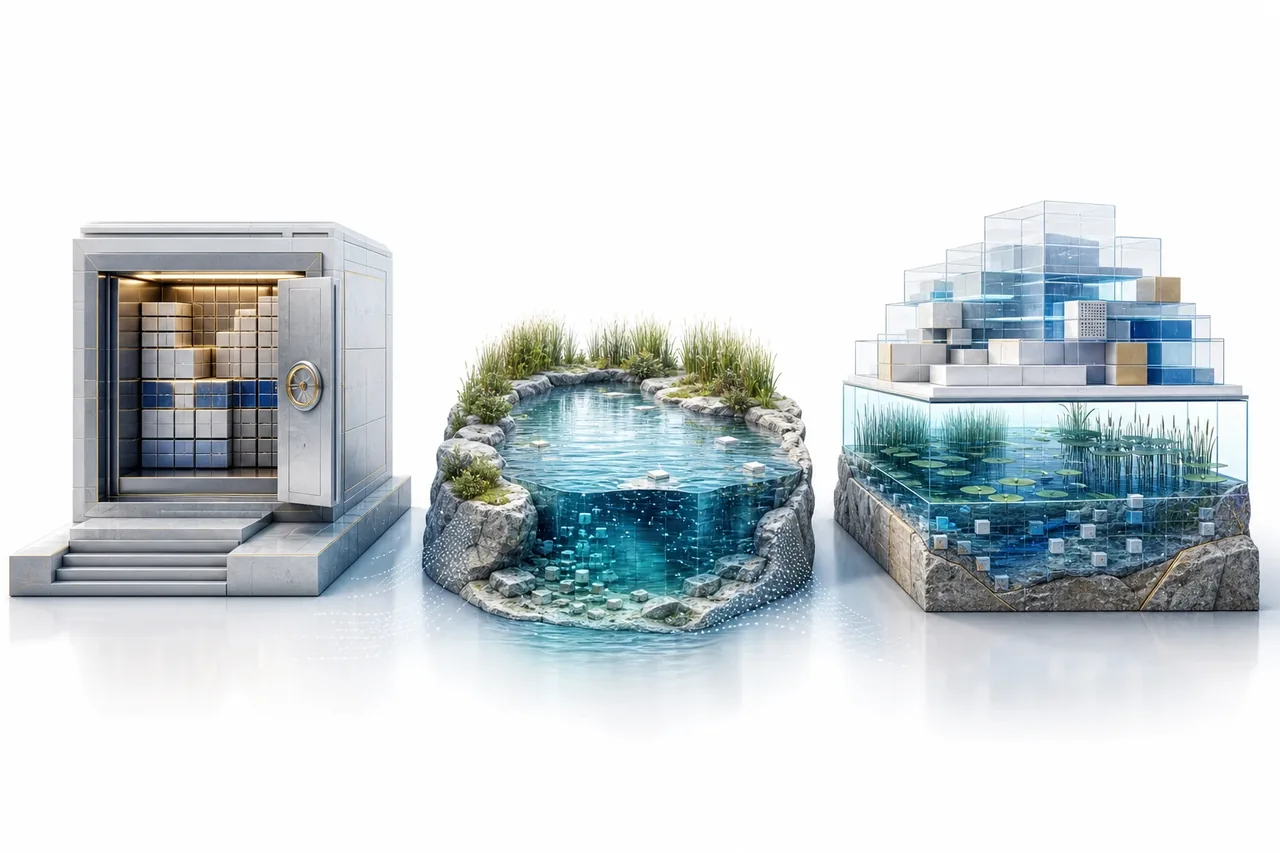
Most "data warehouse vs lakehouse" articles are written by vendors selling one of the two. The conclusion is predictable: if the byline belongs to a lakehouse company, the warehouse is legacy; if it belongs to a warehouse company, the lake is a swamp. Neither framing survives contact with a real enterprise that has finance reporting on one side, a data science team on the other, and a CFO who wants both numbers to reconcile.
This is a decision piece. We define the three architectures, put them side by side, and then make the case that most outlets skip: in 2026 there are still workloads where the enterprise data warehouse is the right answer on the metrics finance actually checks. Governed BI, regulated reporting, and sub-second dashboards at high concurrency remain places where a mature EDW beats a lakehouse. The lakehouse wins on volume and AI. It does not win on governed BI, and that is the argument this post makes.
Three architectures, defined
The terms get used loosely, so start with definitions that stand on their own.
An enterprise data warehouse (EDW) is a centralized analytical database for structured, integrated data modeled for reporting and BI. It uses schema-on-write, so data conforms to a defined model before it lands, and it optimizes for fast, concurrent SQL over curated, governed tables. See our primer on what a data warehouse is, and our guide to data warehouse architecture in 2026 for how that model is built today.
A data lake holds raw data in its native format, structured or not, on cheap object storage. Structure is applied at query time (schema-on-read), which optimizes for cheap storage and exploratory access. We cover this in what a data lake is, and the design choices behind it in data lake architecture in 2026.
A data lakehouse puts an open table format (Apache Iceberg, Delta Lake, or Apache Hudi) over object storage to bring ACID transactions, schema enforcement, and time travel to data-lake files, so one layer serves both BI and ML without copying data into a separate warehouse. The longer version lives in what a data lakehouse is.
The lakehouse is the youngest of the three. Databricks formalized the term around 2020, but the technical achievement underneath it is concrete: ACID guarantees on cloud object storage. That is what Delta Lake, Iceberg, and Hudi do, and it is why the lakehouse stopped being a marketing word and became an architecture you can run in production.
The three-way comparison
| Dimension | Enterprise Data Warehouse | Data Lake | Lakehouse |
|---|---|---|---|
| Storage | Proprietary columnar, tightly coupled to compute | Open files (Parquet, ORC, JSON) on object storage | Open files plus a table-format metadata layer on object storage |
| Schema | Schema-on-write, enforced at load | Schema-on-read, applied at query | Schema-on-write optional, enforced by the table format |
| Governance | Mature, centralized, fine-grained; decades of tooling | Weak by default; "governance inversion" - self-service ingest, central accountability | Improving; catalog-driven (Unity Catalog, Apache Polaris, Lakekeeper) but younger |
| Cost profile | Higher per-TB; storage and compute often bundled | Lowest storage cost; hidden cost in cleanup and query inefficiency | Low object-storage cost; compute decoupled and elastic |
| BI fit | Excellent - high concurrency, predictable latency | Poor - raw data, no serving layer | Good and improving; depends on the query engine |
| ML fit | Limited - data must be exported | Native - raw and semi-structured data at scale | Native - same data serves training and analytics |
| Query latency (our experience) | Sub-second to seconds on curated tables | Seconds to minutes | Seconds, sub-second with a fast engine on optimized tables |
The EDW is strongest exactly where the lakehouse is still catching up (governance maturity, BI concurrency, predictable latency), and weakest exactly where the lakehouse is native (semi-structured data, ML, cost at petabyte scale). They make opposite trade-offs.
The data lake on its own is rarely the destination anymore. Left ungoverned, a lake accumulates unmanaged datasets faster than anyone can classify them: ingestion is self-service but accountability stays central, a mismatch some practitioners call "governance inversion." The lakehouse exists largely to fix that. So the live decision for most teams in 2026 is EDW versus lakehouse, with the raw lake sitting underneath the lakehouse as its storage tier.
Where the EDW still wins in 2026
The lakehouse is winning adoption, but adoption is not the same as fit. Four workloads still favor a mature EDW.
Governed BI at high concurrency. When hundreds of analysts hit a finance dashboard at 9 a.m. on close day, the metric that matters is concurrent query latency. Cloud warehouses isolate workloads (separate Snowflake virtual warehouses, BigQuery slot reservations, Redshift workload queues), so a heavy data-engineering job does not slow down the BI pool; a classic on-prem EDW does not get this for free. Lakehouse query engines have closed much of this gap on optimized tables, but not all of it, and the remaining gap is widest under bursty, high-concurrency BI traffic.
Regulated and finance-grade reporting. Schema-on-write is a feature here. When data must conform to a defined model before it lands, you can enforce governance, lineage, and access control at ingestion rather than hoping a query writer applies them later. For SOX, Basel, HIPAA, and similar regimes, that ingestion-time enforcement and decades of mature audit tooling are hard to replicate on a younger catalog stack.
Sub-second dashboards on curated data. Warehouses sit on tables that have already been modeled, indexed, and pre-aggregated into a semantic layer, and the query planner has statistics it can trust. A lakehouse can hit sub-second latency, but it usually needs a fast engine (a ClickHouse-class system) plus deliberate table maintenance to get there. The EDW gives you that latency closer to out of the box.
Mature SQL tooling and team skills. A platform decision is also a people decision. Your BI developers know the warehouse's SQL dialect, its modeling conventions, and its stored-procedure ecosystem. Re-platforming means retraining people and re-validating reports the business already trusts. That migration cost is real, and for a stable BI estate it can dwarf any compute savings.
None of this means the EDW is where new petabyte-scale or AI work should go. It means the EDW earns its keep for a specific, durable slice of the workload, and ripping it out to chase architectural fashion is how teams break reports that took years to certify.
Is "the EDW" in 2026 a product or a set of practices? In practice it means Snowflake, BigQuery, or Redshift, and all three now read and write Iceberg. What still wins is less the product than the practices: schema-on-write, a semantic layer, workload isolation, certified tables. You can apply most of those on Iceberg tables with a fast engine and a good catalog, but you have to build them, whereas the warehouse ships them. The gap is engineering effort and tooling maturity, not capability.
Where the lakehouse takes over
The lakehouse case is mostly about data the warehouse was never good at.
Semi-structured and unstructured data (JSON event streams, logs, images, embeddings) flow into a lakehouse without a rigid up-front model. ML and AI workloads read the same files used for analytics, so there is no nightly export to a separate feature store and no second copy to reconcile. At petabyte scale the cost math tilts hard: object storage is cheap, compute decouples and scales independently, and you stop paying warehouse rates to store cold data you query twice a year. Open table formats also break vendor lock-in, since the same Iceberg or Delta tables can be queried by Trino, Spark, ClickHouse, Snowflake, or Databricks. We make the longer technical case in why Iceberg is the bright future of data warehousing, and the format choice itself in Iceberg vs Delta Lake.
The adoption numbers point the same way, with the caveat that they come from a lakehouse vendor. In Dremio's 2025 State of the Data Lakehouse survey of 563 IT decision-makers (conducted by Propeller Insights in Q4 2024), 67% said they plan to run the majority of their analytics on a lakehouse within three years, up from 55% at the time of the survey. 41% had moved from a cloud data warehouse and 23% from a data lake. And 85% reported using the lakehouse for AI model development. Read those as a vendor's numbers, but the direction matches what we see in client work: the AI workload is pulling architecture decisions toward open table formats faster than BI ever did.
Governance is the caveat. The same survey found 36% citing governance as a major challenge for AI-driven analytics on the lakehouse. Catalogs like Unity Catalog, Apache Polaris (an ASF top-level project since February 2026), and Lakekeeper are closing that gap, but a catalog ecosystem that is a few years old is not yet the equal of two decades of warehouse access-control tooling. That is why the regulated-reporting workload above still tends to stay on the EDW.
The hybrid most enterprises actually run, and how to decide
Large data organizations mostly do not pick one. They assign each architecture the workload it serves best: EDW for governed BI and regulated reporting, lakehouse for ML and large-scale analytics on open formats, with the raw lake as the shared storage tier underneath. The blurring helps. Snowflake, BigQuery, and Redshift now read and write Iceberg, and Databricks serves warehouse-style SQL, so "are these EDWs or lakehouses?" increasingly answers "both." A single semantic layer over the lakehouse, plus warehouse-grade governance on the BI tables, is the configuration that reconciles the CFO's two numbers. For the full layered view, see our architectures of a modern data platform and the Databricks vs Snowflake comparison.
A short decision framework. For most enterprises the answer is the third option; the first two describe the edges.
- Stable BI estate, heavy regulatory load, certified reports, small data-engineering team. Keep the EDW. The migration cost outweighs the upside, and you would be re-validating reports to save on compute you are not over-spending on.
- Growing semi-structured volume, active ML/AI program, cost pressure at scale. Build on a lakehouse. Pick a table format (Iceberg or Delta) and a catalog before you pick a query engine.
- Both at once. Run the hybrid. Put BI on the warehouse, ML on the lakehouse, share storage, and unify governance through one catalog so lineage and access control hold across both.
The lakehouse is the default for new, large, AI-adjacent data work, and the enterprise data warehouse remains the right tool for governed, high-concurrency, regulated BI. Treat them as complementary and the hybrid stops being a compromise.
Key takeaways
- The live decision is EDW vs lakehouse; the raw data lake is now the storage tier underneath a lakehouse, not a standalone destination.
- What the EDW still wins is mostly a set of practices (schema-on-write, semantic layer, workload isolation) that ship with the warehouse and have to be built on a lakehouse.
- Migration cost, regulatory load, and team skills decide as much as data volume, which is why most enterprises end up running both under one catalog.