

 Itamar Syn-Hershko
Dense vectors dominate the conversation around semantic search, but sparse vectors still solve problems dense embeddings can't. This guide breaks down how each works, where each fails, and why understanding both is non-negotiable for modern retrieval systems.
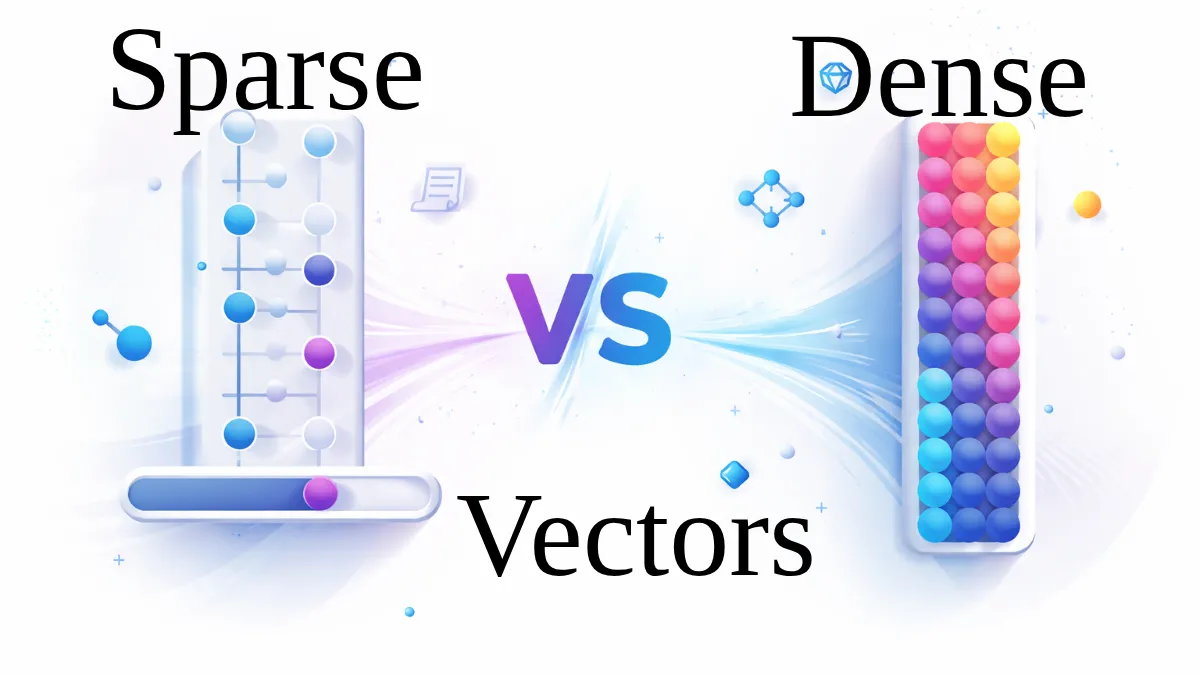
Every keyword search you've ever run is a sparse vector operation. Every time BM25 scores a document, it's comparing sparse representations - arrays of term weights where most values are zero. This has worked well for decades. But the way people search is changing fast.
LLMs now generate search queries on behalf of users. ChatGPT alone has 800 million weekly active users, and 69% of Google searches end without a click as AI-generated answers take over. When ChatGPT does web search, when Claude Code looks up documentation, when Perplexity retrieves sources - they don't type keywords the way humans do. They paraphrase, they expand, they use conceptual language. A user asking "how to create an index in Elasticsearch" might trigger an LLM query for "Elasticsearch index creation API REST endpoint syntax." If your search system only does keyword matching, it will return results about "auto index rollover" or "index lifecycle management" instead of the actual "Create Index API" page. Your precision drops. Your recall drops. Your users get bad answers.
This is why understanding both sparse and dense vectors - what they actually do, where each one breaks - matters more now than ever. If you're new to vector search in general, start with our introduction to vector search with OpenSearch and Elasticsearch.
Sparse Vectors: From BM25 to Learned Representations
A sparse vector is a high-dimensional representation where most values are zero. Each non-zero dimension corresponds to a specific feature - typically a word, token, or n-gram. A document about "Elasticsearch cluster optimization" might produce a vector with 30,000 dimensions, but only a few dozen carry non-zero weights.
Classic Sparse: TF-IDF and BM25
TF-IDF (Term Frequency-Inverse Document Frequency) weights terms by how often they appear in a document relative to the corpus. Common words get low weight. Rare, domain-specific terms get high weight.
BM25 improves on TF-IDF with saturation functions and document length normalization. It's the backbone of lexical search in Elasticsearch, OpenSearch, and every Lucene-based system. BM25 scores around 0.429 nDCG@10 on the BEIR benchmark averaged across 18 datasets - a solid baseline that many dense models struggled to beat until recently.
The strengths are real: sub-millisecond latency through inverted indexes, full explainability (you can see that "Elasticsearch" matched with weight 4.2 and "cluster" with weight 3.8), no GPU required, and battle-tested reliability.
The weakness is just as real: a query for "automobile" won't match documents about "cars." The word "learn" won't match "teach." BM25 has zero semantic understanding.
Learned Sparse: SPLADE and Beyond
SPLADE (Sparse Lexical and Expansion) bridges this gap. It uses BERT's masked language modeling head to expand terms contextually while maintaining sparsity. Feed it "affordable electric cars" and it generates a sparse vector that includes weights for "cheap," "vehicle," "price," and "Tesla" - terms not in the original text but semantically related. The key insight: SPLADE doesn't just learn synonyms. It learns which expansions matter for retrieval.
The latest generation of learned sparse models pushes further. LACONIC, built on Llama-3, achieves 60.2 nDCG@10 on the MTEB Retrieval benchmark - the only sparse model in the top 15, a position dominated by dense retrievers. It also uses 71% less index memory than an equivalent dense model.
| Model | Type | nDCG@10 (BEIR avg) | GPU Required | Explainable |
|---|---|---|---|---|
| BM25 | Classic sparse | 42.9 | No | Yes |
| SPLADE v3 | Learned sparse | 51.3 | For encoding | Partially |
| CSPLADE | Learned sparse | 54.6 | For encoding | Partially |
| LACONIC-8B | Learned sparse | 60.2 | For encoding | Partially |
Learned sparse models still run on inverted indexes at query time. The GPU cost is only at indexing. That's a meaningful operational advantage over dense retrieval.
Dense Vectors: Semantic Power at a Cost
A dense vector is fully populated - every dimension carries a value, learned through neural networks. Where sparse vectors say "this document contains the word cluster with weight 3.8," dense vectors encode something more abstract: the meaning of the text as a point in a high-dimensional space. Two documents that discuss the same concept end up near each other, even if they share no words.
The Embedding Model Landscape
The field moves fast. As of early 2026, the MTEB leaderboard looks very different from a year ago:
| Model | Dimensions | MTEB Score | Cost per 1M tokens | Open Source |
|---|---|---|---|---|
| Google Gemini Embedding | 3072 | 68.3 | ~$0.004/1K tokens | No |
| NV-Embed (NVIDIA) | 4096 | 69.3 | Self-host | Yes |
| Qwen3-Embedding-8B | 1024 | 70.6 (multilingual) | Self-host | Yes (Apache 2.0) |
| Cohere Embed v4 | 1536 | 65.2 | $0.12 | No |
| OpenAI text-embedding-3-large | 3072 | 64.6 | $0.13 | No |
| BGE-M3 | 1024 | 63.0 | Self-host | Yes (MIT) |
Open-source models now match or exceed closed-source alternatives. Qwen3-Embedding and NV-Embed lead the MTEB leaderboard while being free to self-host. For teams that can run inference infrastructure, this eliminates per-token API costs entirely.
Matryoshka Representation Learning makes high-dimensional models more practical. Models trained with MRL let you truncate embeddings - say, from 3072 to 768 dimensions - while retaining 90-95% of retrieval accuracy. OpenAI's text-embedding-3-large at 256 dimensions still outperforms their older ada-002 at 1536 dimensions. This means you can trade a small accuracy hit for 4-12x less memory and proportionally faster search.
Token Limits and Chunking
Every embedding model has an input limit. BERT-based models typically cap at 512 tokens. Newer models like BGE-M3 and OpenAI's embeddings accept up to 8,192 tokens. But even with a high token limit, embedding a 20,000-word document as a single vector is a bad idea. Different sections discuss different topics, and a single vector can't faithfully represent all of them.
This is where chunking comes in. You split documents into coherent segments - each one gets its own vector representing its specific meaning. Research on optimal chunk sizes shows recursive 512-token splitting with 10-20% overlap as a pragmatic starting point, though domain-specific content may benefit from topic-boundary chunking that aligns splits with logical section breaks.
The chunking strategy you pick matters as much as your embedding model choice. Get it wrong and you'll embed fragments too small to carry meaning or chunks too large to be specific.
HyDE: Flipping the Retrieval Problem
HyDE (Hypothetical Document Embeddings) takes a different approach to the query-document mismatch problem. Instead of embedding the user's query and hoping it lands near the right documents, you ask an LLM to generate a hypothetical answer - even if it's wrong - and embed that instead. The hypothesis shares vocabulary and structure with real documents, so its embedding lands closer to relevant results.
On TREC DL-20, HyDE achieves nDCG@10 of 61.3 versus 44.5 for the unsupervised Contriever baseline - a 38% improvement with zero training data. The trade-off is latency: you're adding an LLM generation step before retrieval, which adds 25-60% overhead depending on model size.
HyDE works best for short, ambiguous queries where the direct embedding would be too vague. For keyword-heavy or exact-match queries, it adds cost without benefit.
The Cost of Dense Search
Dense vectors aren't cheap at scale. A collection of 10 million documents with 1536-dimensional float32 embeddings requires roughly 60GB just for the vectors - all of which needs to be in memory or on fast storage for ANN search. We've written extensively about reducing this footprint with Cohere Embed 4's Matryoshka support and scaling vector search to billions of documents. The scoring is opaque: you get a similarity score of 0.87, but there's no breakdown of why two items matched. In regulated industries - healthcare, finance, legal - this lack of explainability can be a dealbreaker.
Elasticsearch offers its own sparse model, ELSER, as an alternative to external dense embeddings - worth evaluating if you're already in the Elastic ecosystem.
There's also a subtler failure: semantic drift. A query about "Python 3.11 performance improvements" might return results about "Python optimization techniques" in general. The embeddings are close in vector space, but the retrieved documents don't actually answer the question. You know that results matched but not why, which makes debugging these failures harder than debugging a BM25 miss.
Where Each Approach Fails
Neither sparse nor dense retrieval is universally better. Each has failure modes that the other handles well.
Dense Vector Failures
Semantic drift. Dense models retrieve conceptually related but factually wrong results. Searching for a specific error code like FORBIDDEN/12/index read-only might return generic articles about Elasticsearch permissions instead of the exact troubleshooting page.
Over-generalization. Model numbers, API endpoint names, error messages, product SKUs - anything that demands exact lexical matching is a weak spot. Dense embeddings can miss the exact document while returning ten "close enough" alternatives.
Hallucinated similarity. Two documents using similar language about completely different topics can score high. A document about "scaling a Redis cluster" and one about "scaling an Elasticsearch cluster" might get near-identical embeddings, even when only one is relevant.
Sparse Vector Failures
Synonym gaps. Without expansion (like SPLADE), "automobile" doesn't match "car." "Laptop" doesn't match "notebook computer." This is the classic vocabulary mismatch problem.
No semantic understanding. "The product is not bad" and "The product is bad" differ by one word, but their sparse representations are nearly identical. Sparse vectors can't handle negation, sarcasm, or implied meaning.
LLM query mismatch. As search queries increasingly come from LLMs rather than humans, the gap between how queries are phrased and how documents are written keeps growing. An LLM might search for "containerized deployment orchestration platform comparison" when the relevant document title is "Kubernetes vs Docker Swarm."
The Takeaway
Research confirms what production systems have shown: to reach a recall@1000 of 0.98, you need both sparse and dense retrieval. Neither alone gets there. For a deeper look at tuning relevance in practice, see our guide to optimizing Elasticsearch relevance. For running hybrid search affordably at large scale on AWS, see OpenSearch with S3 Vectors for cost-efficient hybrid vector search.
Frequently Asked Questions
What is a sparse vector in search?
A sparse vector is a high-dimensional representation where most values are zero and each non-zero dimension corresponds to a specific term, token or n-gram. TF-IDF and BM25 scoring are sparse vector operations: a document might map to 30,000 dimensions with only a few dozen carrying non-zero weights.
What is a dense vector?
A dense vector is fully populated - every dimension carries a value learned by a neural network - and encodes the meaning of a text as a point in a high-dimensional space. Two documents about the same concept end up near each other even if they share no words.
Is BM25 still relevant now that dense embeddings exist?
Yes. BM25 scores around 0.429 nDCG@10 on the BEIR benchmark, runs with sub-millisecond latency on inverted indexes, needs no GPU, and is fully explainable. It remains the best choice for exact-match needs such as error codes, model numbers and SKUs, but it has zero semantic understanding and cannot match "automobile" to "car".
What is learned sparse retrieval like SPLADE?
Learned sparse models such as SPLADE use a language model to expand a text with semantically related terms while keeping the vector sparse, so it still runs on an inverted index at query time. SPLADE v3 reaches 51.3 nDCG@10 on BEIR and LACONIC-8B reaches 60.2 on MTEB Retrieval while using 71% less index memory than an equivalent dense model; GPUs are only needed at indexing time.
Should I use sparse or dense vectors for search?
Use both. Research shows reaching a recall@1000 of 0.98 requires combining sparse and dense retrieval, and hybrid search that fuses the two improves recall 15-30% over either method alone. Dense vectors handle paraphrased and LLM-generated queries, while sparse vectors handle exact matches and explainability.
What is HyDE in retrieval?
HyDE (Hypothetical Document Embeddings) asks an LLM to generate a hypothetical answer to the query and embeds that instead of the raw query, so the embedding lands closer to real documents. On TREC DL-20 it achieves 61.3 nDCG@10 versus 44.5 for the Contriever baseline, a 38% improvement, at the cost of 25-60% added latency from the extra LLM call.
Key Takeaways
Keyword search alone won't survive the AI era. LLMs generate queries differently from humans - more conversational, more paraphrased, less keyword-dependent. Systems that rely solely on BM25 will see increasing recall degradation.
Sparse vectors aren't obsolete. BM25 still dominates for exact-match scenarios, and learned sparse models like LACONIC now compete with dense retrievers on benchmark accuracy while using 71% less index memory.
Dense vectors aren't magic. They excel at semantic matching but fail on exact precision, explainability, and cost at scale. A 10M document collection needs ~60GB just for vector storage at 1536 dimensions.
Chunking strategy matters as much as model choice. Dense vectors require splitting documents into coherent segments. Bad chunking - too small, too large, or splitting mid-thought - can undermine even the best embedding model.
HyDE is worth considering for ambiguous queries. Generating a hypothetical answer before embedding can boost retrieval by 38%, but at the cost of added latency from an LLM call.
The production standard is combining both. Hybrid search - running sparse and dense retrieval in parallel and fusing results - improves recall 15-30% over either method alone. For a hands-on walkthrough, see our guide on building hybrid search with OpenSearch. For scaling considerations, check out scaling vector search from millions to billions. And if you're evaluating how to measure whether your search results are actually good, start with why precision and recall matter more than you think.